By C. J. CHIVERS
APRIL 6, 2016
 A terrorist hoping to buy an antiaircraft weapon in recent years needed to
look no further than Facebook, which has been hosting sprawling online
arms bazaars, offering weapons ranging from handguns and grenades to
heavy machine guns and guided missiles.
A terrorist hoping to buy an antiaircraft weapon in recent years needed to
look no further than Facebook, which has been hosting sprawling online
arms bazaars, offering weapons ranging from handguns and grenades to
heavy machine guns and guided missiles.
The Facebook posts suggest evidence of large-scale efforts to sell
military weapons coveted by terrorists and militants. The weapons
include many distributed by the United States to security forces and their
proxies in the Middle East. These online bazaars, which violate
Facebook’s recent ban on the private sales of weapons, have been
appearing in regions where the Islamic State has its strongest presence.
 This week, after The New York Times provided Facebook with seven
examples of suspicious groups, the company shut down six of them.
This week, after The New York Times provided Facebook with seven
examples of suspicious groups, the company shut down six of them.
The findings were based on a study by the private consultancy
Armament Research Services about arms trafficking on social media in
Libya, along with reporting by The Times on similar trafficking in Syria,
Iraq and Yemen.
1. The Weapons Have Included Heavy Machine
Guns and Heat-Seeking Missiles
Many sales are arranged after Facebook users post photographs in
closed and secret groups; the posts act roughly like digital classified ads
on weapons-specific boards. Among the weapons displayed have been
heavy machine guns on mounts that are designed for antiaircraft roles
and that can be bolted to pickup trucks, and more sophisticated and
menacing systems, including guided anti-tank missiles and an early
generation of shoulder-fired heat-seeking antiaircraft missiles.
The report documented 97 attempts at unregulated
transfers of missiles, heavy machine guns, grenade
launchers, rockets and anti-matériel rifles, used to disable
military equipment, through several Libyan Facebook groups
since September 2014.


Last year ARES said it had documented an offer on Facebook to sell
an SA-7 gripstock (pictured above), the reusable centerpiece of a manportable
antiaircraft defense system, or Manpads, a weapon of the
Stinger class. Many of these left Libyan state custody in 2011, as depots
were raided by rebels and looters. ARES said it documented Libyan sellers
claiming to have two complete SA-7s for sale, two additional missiles and
three gripstocks. An old system, SA-7s are a greater threat to helicopters
and commercial aircraft than to modern military jets.
 2. Others Are the Standard Arms of Militant
and Terrorist Groups
2. Others Are the Standard Arms of Militant
and Terrorist Groups
Machine guns and missiles form a small fraction of the apparent
arms trafficking on Facebook and other social media apps, according to
Nic R. Jenzen-Jones, the director of ARES and an author of the report.
Examinations by The Times of Facebook groups in Libya dedicated to
arms sales showed that sellers sought customers for a much larger
assortment of handguns and infantry weapons. The rifles have
predominantly been Kalashnikov assault rifles, which are used by many
militants in the region, and many FN FAL rifles, which are common in
Libya.
All of these solicitations violate Facebook’s policies, which
since January has forbidden the facilitation of private sales of firearms
and other weapons, according to Monika Bickert, a former federal
prosecutor who is responsible for developing and enforcing the company’s
content standards.
3. Weapons Sales Greased by Social Media Sites
Have Become a Feature of Many Conflicts
The use of social media for arms sales is relatively new to Libya. Until
a Western-backed uprising against Col. Muammar el-Qaddafi in 2011,
which ended in his death at the hands of an armed mob, the country had
a tightly restricted arms market and limited Internet access. But social
media-based weapons markets in Libya are not unique. Similar
markets exist in other countries plagued in recent years by
conflict, militant groups and terrorism, including arms-sales
Facebook groups in Iraq, Syria and Yemen.
On Monday, The Times shared links for seven such groups with
Facebook to check whether they violated the rules. By Tuesday, Facebook
had taken down six of the groups. Ms. Bickert said that one Facebook
group — which displayed photographs of weapons but only discussed
them and expressly forbade sales — had survived the company’s scrutiny.
 4. Facebook’s Rules on Arms Sales Are Related
to Changes in How Facebook Is Used.
4. Facebook’s Rules on Arms Sales Are Related
to Changes in How Facebook Is Used.
Ms. Bickert described the company’s policies as evolutionary,
reflecting shifts in its social media ecosystem.
“When Facebook began, there was no way to really engage in
commerce on Facebook,” she said. But in the past year, she noted, the
company has allowed users to process payments through its Messenger
service, and has added other features to aid sales. “Since we were offering
features like that, we thought we wanted to make clear that this is not a
site that wants to facilitate the private sales of firearms.”
It is not clear how extensive arms trafficking on the site has been, but
the rate of new posts has been unmistakably brisk, with many groups
offering several new weapons a day. Mr. Jenzen-Jones said that ARES
documented 250 to 300 posts about arms sales each month on the Libya
sites alone, and that sales appeared to be trending up. Over all, using data
from arms-sales Facebook groups across the Middle East, he said, “We’ve
got about 6,000 trades documented, but it’s probably much bigger than
that.”
5. Facebook Relies on Users to Report the Arms
Trafficking It Bans
Ms. Bickert said the most important part of Facebook’s
effort “to keep people safe” was to make it easy for users to
notify the company of suspected violations, which can be done
with a click on the “Report” feature on every Facebook post.
In this way so-called Community Operations teams — Facebook
employees who review the reports in dozens of languages — can examine
and remove offending content. How effective the policy is, in
practice, is unclear. Several groups from which the photographs for
this article were downloaded operated on Facebook for two years or more,
accumulating thousands of members before Facebook announced its ban
on arms sales.
This trafficking occurred in countries where the Islamic
State is at its most active and where armed militias or other
designated terrorist groups, including Al Qaeda, have a persistent
presence. In all four countries, government forces do not control large
areas of territory and civil society is under intense pressure. Christine
Chen, a Facebook spokeswoman, said the company relied on the nearly
1.6 billion people who visit the site every month to flag offenders. “We
urge everyone who sees violations to report them to us,” she said.

ARES has documented many types of buyers and sellers. These
include private citizens seeking handguns as well as representatives of
armed groups buying weapons that require crews to be operated
effectively, or appearing to offload weapons that the militias no longer
wanted. Different markets have different characteristics. In Libya, fear
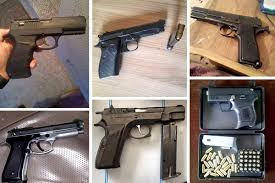
of crime seemed to drive many people to buy pistols, Mr.
Jenzen-Jones said.
“Handguns are disproportionately represented,” he said. “They are widely
sought after — primarily for self-defense and particularly to protect
against carjackings — with many prospective buyers placing ‘wanted’
posts.” They were also expensive, ranging from about $2,200 to more
than $7,000 — a sign that demand outstrips supply.
7. Weapons Provided to Allies in Iraq Have
Filled Facebook Sales Pages
In Iraq, the Facebook arms bazaars can resemble inside looks at the
failures of American train-and-equip programs, with sellers
displaying a seemingly bottomless assortment of weapons
provided to Iraq’s government forces by the Pentagon during
the long American occupation. Those include M4 carbines, M16 rifles,
M249 squad automatic weapons, MP5 submachine guns and Glock
semiautomatic pistols. Many of the weapons shown still bear inventory
stickers and aftermarket add-ons favored by American forces and troops.
Such weapons have long been available on black markets in Iraq,
with or without advertising on social media. But Facebook and other
social media companies seem to provide new opportunities for sellers and
buyers to find one other easily; for sellers to display items to more
customers; and for customers to peruse and haggle over a larger
assortment of weapons than what is available in smaller, physical
markets.
8. In Syria, Weapons Identical to Those
Distributed to Rebels by the United States Are
Offered for Sale
Similarly, weapons identical to those provided by the United States to
Syrian rebels have also been traded on Facebook and other social
media or messaging apps. In one recent example, a seller in northern
Syria — who identified himself as a student, photographer and sniper —
offered a pristine-looking Kalashnikov assault rifle that he said came from
the Hazm Movement, which received weapons from the United States
before the movement was defeated by the Nusra Front, a Qaeda affiliate.
He noted on Facebook that the rifle was new and had “never fired a shot,”
and hinted of either a bonus gift or a discount.
In another example, from October, a Facebook arms-trading group
offered a “new TOW launcher,” referring to a wire-guided anti-tank
missile system of the same type provided to rebels by the United States
and other countries. The post included a phone number for the seller,
which linked to WhatsApp, a messaging service. Reached on
WhatsApp this week, the seller, whose profile picture shows
the face of a corpse, said that he had sold the launcher but
added, unconvincingly, that he could not recall the price.
 9. Social Media Pages Help Armed Groups Find
Other Military Equipment
9. Social Media Pages Help Armed Groups Find
Other Military Equipment
Items offered for sale on Facebook in Libya also included much of the
other equipment sought by militias or terrorists for their operations.
These included ammunition, bulletproof plates for flak jackets, rifle
scopes, hand grenades, two-way tactical radios, fragmenting
antipersonnel warheads for rocket-propelled grenade launchers, uniforms
(including police uniforms) and forward-looking infrared cameras, used
for night imaging.
Ms. Bickert said that using Facebook to help sell items not considered
weapons, like bulletproof plates, did not violate the company’s rules.
Since the same groups selling plates were also selling weapons, however,
they were removed this week.
Online arms trafficking of this magnitude is an “eye opener,” said
Nicolas Florquin, research coordinator for the Small Arms Survey, the
Geneva-based international research center that underwrote the ARES
study, part of an effort to supplement trafficking investigations by the
United Nations Panel of Experts. Without addressing Facebook or any
particular social-media company directly, he added, “Obviously there
has to be more attention to monitoring and controlling it.”
 10. Facebook Groups Also Offer Residents a
Means to Flee
10. Facebook Groups Also Offer Residents a
Means to Flee
One of the arms-trading pages that Facebook took down this week
included a stray advertisement, among ones for weapons and crates of 82-
millimeter mortar rounds. It was for people looking to escape the miseries
and dangers that have settled over some of the territory where such
Facebook pages have been a feature of the arms trade. The advertisement
offered open-ocean boat rides. Passage to Greece, it said, was
“guaranteed.” The advertisement was of a type. In a region struggling
with large-scale violence and overrun by militias, terrorists and the many
forces fighting them, Facebook groups dedicated to refugee trafficking
promise the chance to escape.
Karam Shoumali contributed reporting from Turkey, and Shuaib Almosawa
from Yemen.

